
See how our bridges are getting better by the year…
2025
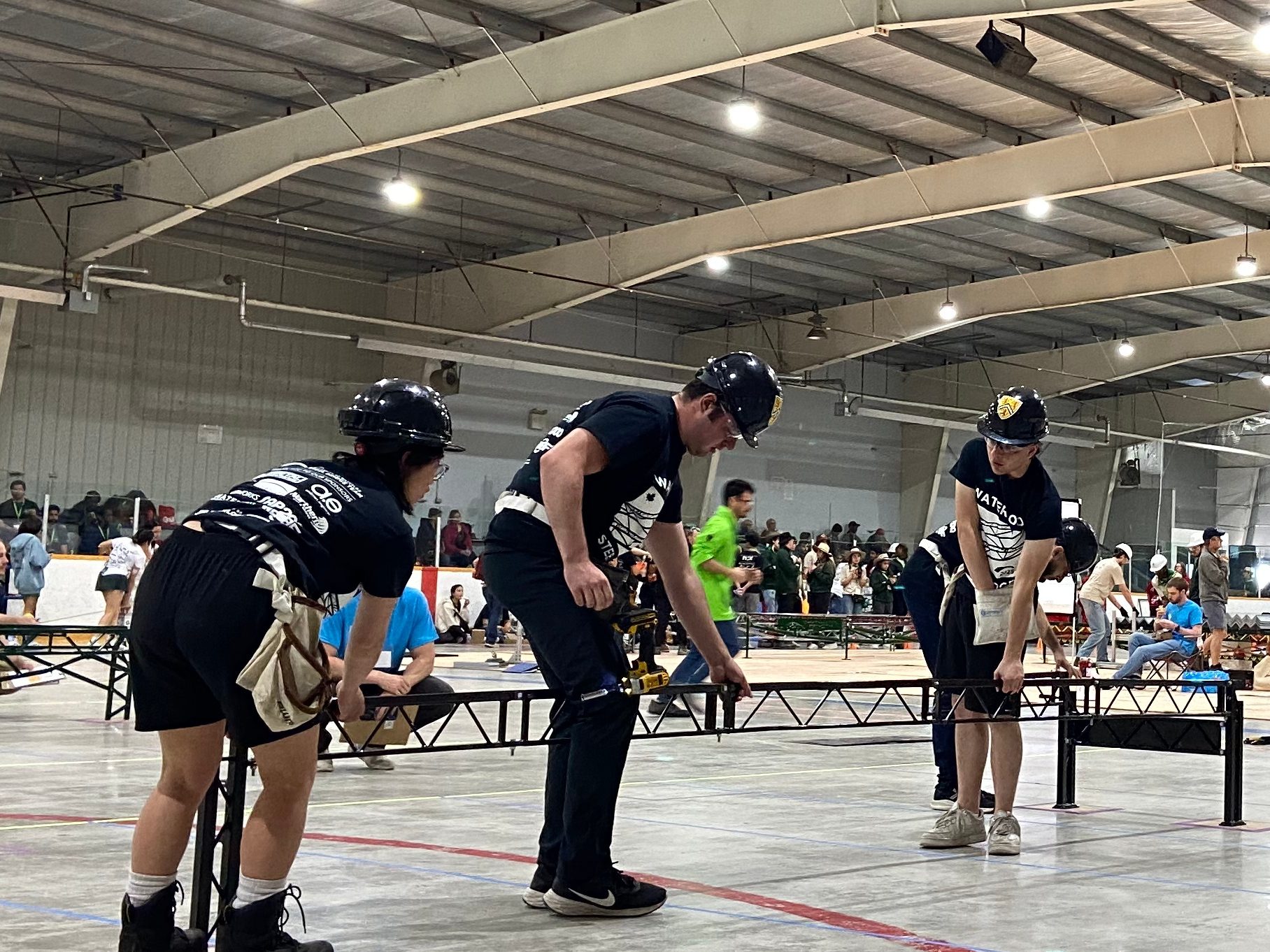
Staggered Deck Truss
2024
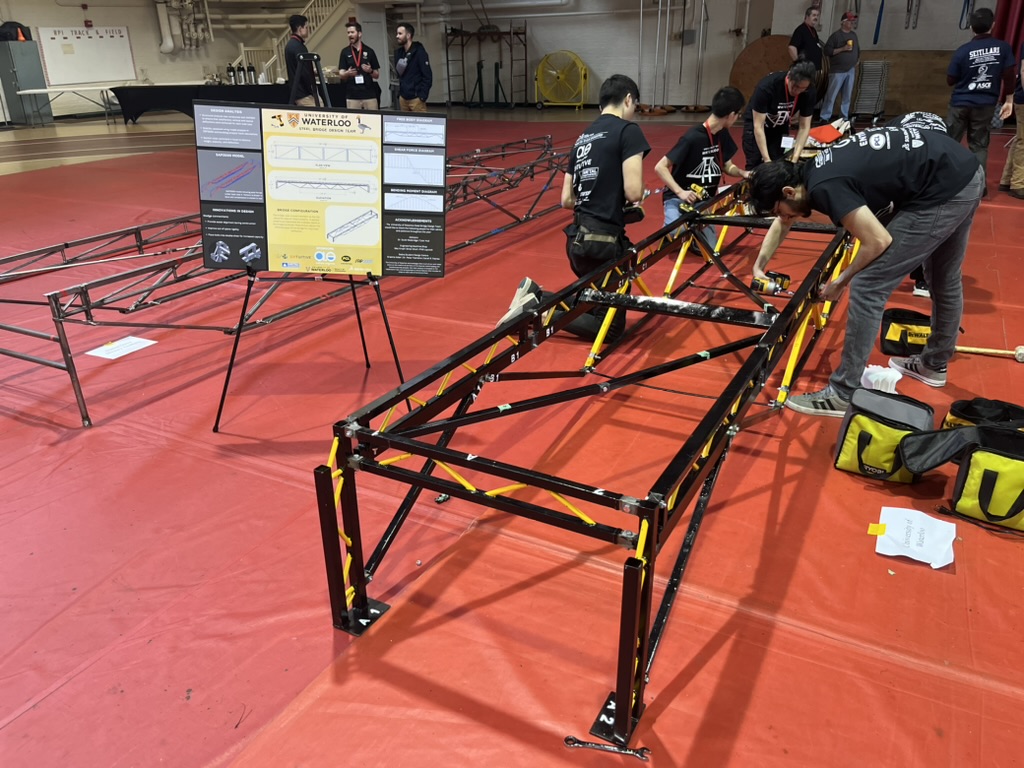
Tried-and-True Deck Truss
Although potential designs maximizing this year’s bridge envelope were explored, the design team ultimately chose a tried-and-true deck truss design, focusing on improving stiffness and structural efficiency. At the Student Steel Bridge Competition, the team secured two 2nd place finishes in design aesthetics and cost estimation, along with two 3rd place finishes in stiffness and structural efficiency. They followed up this success at the Canadian National Steel Bridge Competition by achieving 1st place in both stiffness and structural efficiency categories, with an impressive 0.9 inches of aggregate deflection.
2023
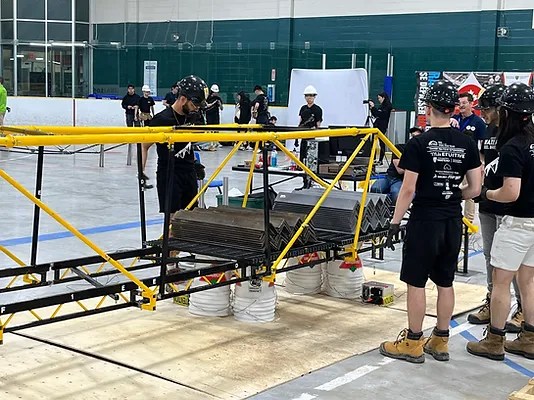
Over Truss
The bridge envelope allowed for construction above the stringers up to a total bridge height of 5 feet, and while arch bridges offer greater stiffness, they are more complex to design, necessitating lateral bracing to prevent buckling. The team utilized simple wedge and plate-to-plate connections, which proved effective, sturdy, and easy to fabricate. Despite failing the vertical load test at the Student Steel Bridge Competition, the team learned valuable lessons and later achieved significant success at the Canadian National Steel Bridge Competition, securing 2nd place in design aesthetics, 3rd in the video category, and 4th overall (3rd in Canada).
2022
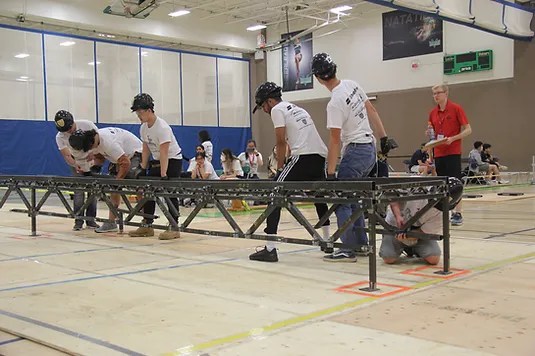
Double Under Truss
The design utilized a double undertruss to maximize the design envelope while adhering to constraints, incorporating moment frames and lateral bracing for increased stiffness and buckling prevention, with components fabricated from square and rectangular HSS. Fabrication was completed by the University of Waterloo Engineering Machine Shop using jigs for consistency and employing only two types of connections, with labeled members to speed up construction. The construction sequence involved building the upper and lower undertrusses, connecting moment frames to the spans, and finishing with the cantilever end and lateral members.
2018
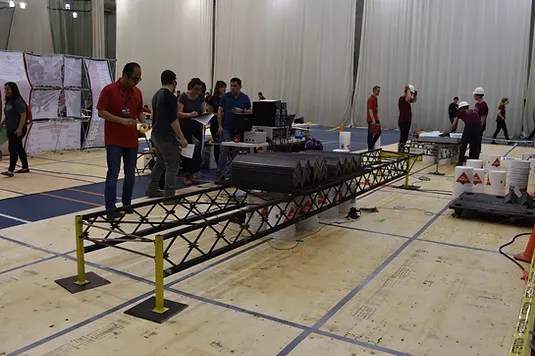
Under Truss
Undertrusses were chosen for their ease and speed of construction, with the top chord acting as a loading rail to eliminate the need for two separate long members, and splitting the trusses into “Upper” and “Lower” halves to maximize depth and reduce weight. To minimize construction time, the trusses were aligned for one plate connection to connect four members, reducing the number of bolted connections, with most connections designed as “dovetail” or plug connections, or pre-welded plate connections. This configuration, along with a horizontal truss at key points to minimize deflection and prevent twisting, aims to greatly reduce construction time by simplifying and reducing the number of bolted connections.
2017
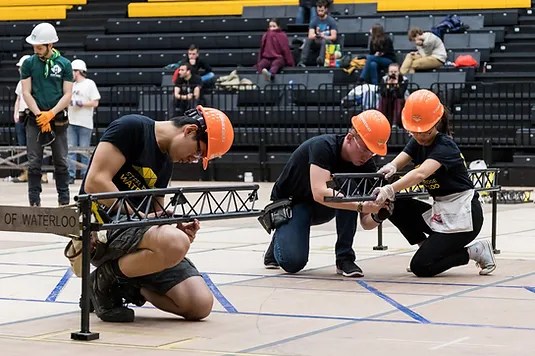
Warren Over-Truss
The design features an overtruss to maximize depth, a Warren truss for optimal load/weight ratio, and cross braces to enhance lateral stiffness. Members made from square HSS improve fabrication efficiency and resist lateral-torsional buckling. Accelerating construction, most bolts are pre-welded, components are jig-fabricated for precision, and uniform connections streamline assembly. In the construction sequence, four legs are placed, loading rails and bottom cross braces are connected, followed by spanning loading rails over the river, supporting midspan with a pier, and constructing over trusses from loading rails and cross braces towards midspan, connecting upper cross braces simultaneously.
2016
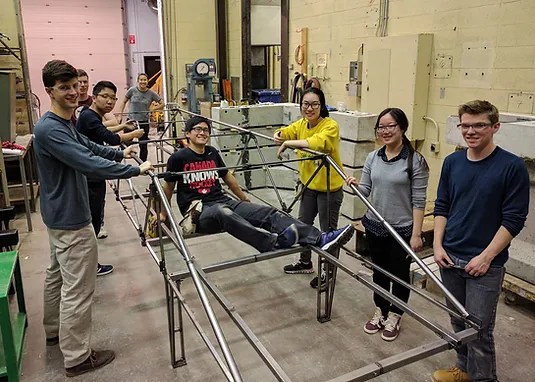
Warren Over-Truss
The design utilizes an overtruss to maximize depth, a Warren truss for load/weight optimization, and cross braces for lateral stiffness and buckling prevention. Members made from square HSS streamline fabrication and resist lateral-torsional buckling. Accelerating construction, pre-welded bolts, jig-fabricated components, and consistent connections expedite assembly, while the construction sequence involves placing four legs, erecting loading rails and bottom cross braces, spanning loading rails over the river, supporting midspan with a pier, and constructing over trusses from loading rails and cross braces towards midspan, connecting upper cross braces simultaneously.
2015
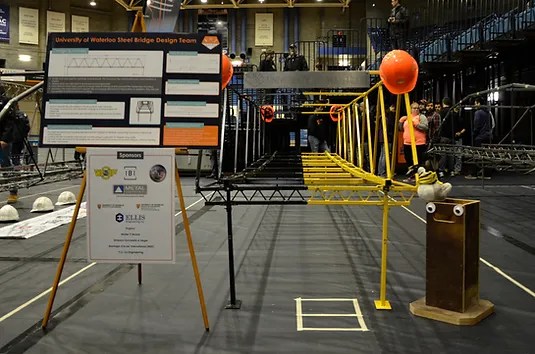
Warren Over-Truss
The design utilizes an overtruss for increased depth, a Warren truss for optimal load/weight ratio, and cross braces to enhance lateral stiffness and prevent buckling. Fabricated from square HSS, members streamline fabrication and resist lateral-torsional buckling. Accelerating construction, pre-welded bolts, jig-fabricated components, and consistent connections expedite assembly, with the construction sequence involving placing four legs, erecting loading rails and bottom cross braces, spanning loading rails over the river, supporting midspan with a pier, and constructing over trusses while connecting upper cross braces simultaneously.
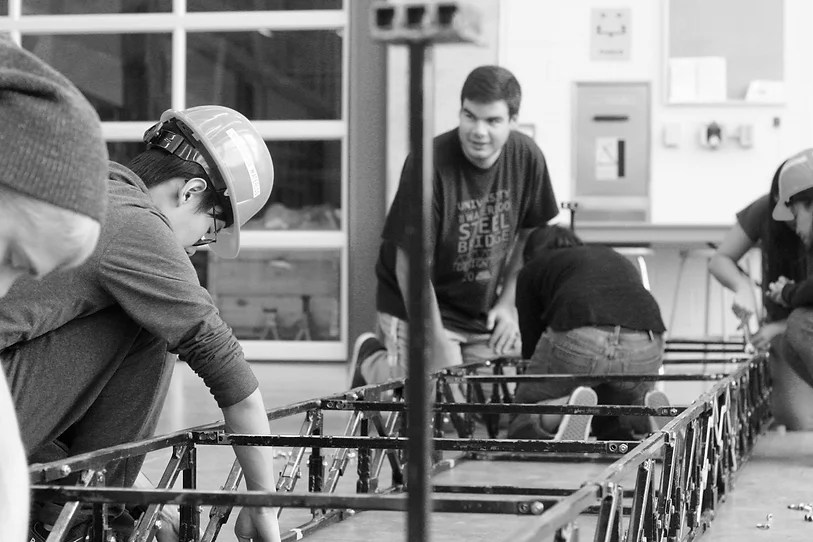
2014
Pratt under Truss
The Pratt under truss design was chosen for its symmetry, repetition, and ability to accommodate simple connection details, allowing for a compact yet maximized component size. To accelerate bridge construction, components are fabricated using jigs to ensure consistency, lightweight hollow steel sections (HSS) are used, and splice plate connections are implemented throughout for faster assembly. The current construction sequence involves placing four legs, connecting the first two truss components to each leg, attaching lateral bracing, building repeating truss components to midspan with simultaneous lateral bracing, and finally installing center truss components at midspan to join the two bridge halves.
 2025 UW Steel Bridge